You can't beat the Weird Sisters of Shakespeare's Scottish Play (no superstition here!) when it comes to conjuring up images of your stereotypical witch. Ugly, withered, old crones hunched over boiling cauldrons chanting evil spells of misfortune and mayhem. Old Will was certainly not original in his portrayals of the ladies with brooms, except, perhaps, for the beards, there is that. Peoples from long ago centuries time traveling to the future would easily recognized the three as such, language barrier or no.
Since it is October, and we've been bombarded with Halloween paraphernalia since approximately July of this year, I thought a story of witches might be appropriate for this month's blog.
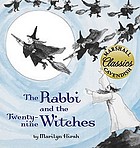
With so many to choose from, I eventually decided on The Rabbi and the Twenty-nine Witches by Marilyn Hirsh, a retelling of a Talmudic legend first published in 1976.

The Rabbi and the Twenty-nine Witches tells the tale of a small, rural village that, at every full moon, is terrorized by twenty-nine of the meanest, scariest, ugliest, and wickedest witches that ever were.
The witches live in a deep, dark cave under a nearby hill. They raise evil rats and buzzards. They fly on brooms. Not only do they screech, they screech hideously. They bite, turn flowers into poison mushrooms, and generally do all kinds of witchy things 24/7, 365 days a week, 366 days on a leap year.
Talk about your bad neighbors.
On top of that, every month on the full moon, they swoop down on their brooms and terrorize the village. Hens laid cracked eggs, cows gave sour milk, and everyone from old folks down to babies suffered terrible nightmares.
The only exception to their clocklike appearance was if it rained. If it rained on the night of a full moon, the witches did not appear.
Generations of villagers had been born and died never seeing a full moon. But, one day, an old grandmother told her friend that she wanted to see a full moon before she died. Her friend advised going to the Rabbi for a solution.
Now, the Rabbi was a very smart and learned man, and he gave the old grandmother's request his undivided attention. He organized the known facts. The witches appeared every full moon, EXCEPT, when it was raining. Then the Rabbi applied reason.
No rain = witches
Rain = witches
The Rabbi made the connection.
It just so happened that it was the day before the next full moon. If it was still raining the next night, the Rabbi would put his idea of how to rid the village of witches to the test.
He told the grandmother to send him twenty-nine of the bravest men in the village on the following night, and each one must bring a long white robe and a clay pot with a tight cover.
The next night, the rain was still falling. He instructed the assembled men to put their robes in the pots and cover the pots tightly. They were brave men, but still frightened, but they did as the Rabbi asked because they trusted him.
When the group made it to the cave, the Rabbi bade them to hide, and he would go inside first. When they heard the first whistle, they were to don their robes. At the second whistle, they were to rush in, pick up a witch, and start dancing.
The Rabbi then donned his own robe, along with a fierce expression, and entered the cave. The witches demanded that he identify himself. The Rabbi claimed to be one of their own, and the witched asked how he managed to stay so dry. The Rabbi responded that he walked between the raindrops.
The Rabbi promised to show them some of his magic after they showed him some of theirs. The witches then magically created a huge feast with golden plates and goblets.
The Rabbi says they should all start eating, but the witches demand some of his magic first. The Rabbi then says he will produce twenty-nine handsome men to dance with them at the feast. He whistled again, and the waiting men come rushing in, each one grabbing a witch and whirling her around.
The Rabbi then promises everyone to teach them his greatest trick, how to dance around raindrops, and tells everyone to go outside. The men pick up the witches and carry them outside, the witches screech in outrage that they were tricked, but it was too late. As soon as the water hits them, they become smaller and smaller and eventually disappear.
But a good feast should never go to waste, so one of the men ran back to the village and told them that the witches were gone forever, whereupon the villagers returned with him to share the feast and celebrate.
Afterwards, when the rain stopped, everyone went outside and gazed at the beautiful full moon. And, when they finally went to bed, no one in the village had a single nightmare.
The Rabbi and the Twenty-nine Witches possesses two aspects that, to me, separate it from your standard folktale/fairytale. The story itself is not surprising, in the end, good triumphs over bad, a message desperately sought by the common folk of any society in any time period. The world has always weighed heavily in favor of the rich and powerful, not the most moral, and the in-your-face consequences of the morally corrupt getting away with murder with little to no consequence has been bitter fact-of-life reality for much of our species existence. Also the source of (it seems to me) a considerable amount of folklore where the little guy wins out in the end, either by showing kindness to a stranger or by using his noggin, thereby winning the kingdom, the emperor's daughter, the hand of the prince, and so on.
The first thing that set the story apart from me was that the bad guys (the witches) were allowed to have a sense of humor. When the Rabbi announces that he will produce handsome men to dance with them, one to the witches remarks that no one has asked her to dance in four hundred years.
The second thing happened once the witches were outside and being killed by the rain. Rather then gloating that ding-dong, the witch is dead and slapping each other high-fives, the men (plural here, not the man, the men, this is important), look on in grief and sadness (huge credit to Ms. Hirsh's illustration) and say that, "... It shouldn't happen to our worst enemies."
Compassion. Regret. Dare we say, empathy?
I loved this book for many reasons. The story was perfect and fit for young ears. The illustrations were a perfect match for the text. Hirsh was a stickler for authenticity, and her wonderful black and white illustrations reflect a small, rural Jewish village of the pre-industrial era.
Go ahead and read it to your class for costume day. Unlike Will's famous play, you can even say the title out loud.
Whenever I read a book purporting to be based on a traditional tale, I try (not always successfully) to locate earlier versions or source material. This story is based on one from the Talmud, of which I know very little. After some searching, I found the below article that specifically addresses the Talmudic source of the book. If you're interested, click on the link. I found it very interesting.
Link to original: http://myparshah.martinperlin.com/2017/09/talmudic-source-for-rabbi-and-29-witches.html
According to Something About the Author, Marilyn Hirsh was born on New Year's Day in 1944 in Chicago, and died October 1988 in NYC. She was an educator, illustrator and author, focusing primarily on Jewish themes. In addition, she served in India in the Peace Corps in the 1960s, and her first picture books had Indian themes. Hirsh considered India her second home.
When she returned to the states, she taught at New York University's Institute of Fine Arts and Cooper Union, specializing in Indian and Buddhist art history.
Marilyn Hirsh papers at the University of Mississippi here.
****************************
I've recently embarked on the journey of self-publication. It's been an education. If you're interested in the process, check out my other blog On the Trail of Rogue Lits ...
For more information on this and upcoming books, check out my bare bones website www.carolmaticbooks.com